The AI back-office for the independent expert witness

The only page-cited chronology that proves its own citations.

Other tools link each line to a page and leave you to check it. CitePage verifies every fact against its source page in code, accounts for every page it read — so nothing is silently dropped — and flags conflicts for your judgment. You author every opinion. Your first chronology is free.

No card required to start · one consented case · you author every opinion.

Every citation verified against its page No silent omissions — coverage accounted Private & never used to train AI You author every opinion
Every citation verified against its page Coverage accounted — no silent omission Exportable discovery-ready audit trail No-train, tenant-isolated

The record-review tax

The most valuable expert in the room is doing the least valuable work.

A single case bundle runs hundreds — sometimes thousands — of pages: medical records, depositions, imaging reports, prior expert disclosures. Reading them is the biggest billable-time sink in the engagement: roughly an hour per 100 pages, 40–50 hours a case. At $400/hr that's about $16,000 of your time spent chronologizing records before you've rendered a single opinion — work that's essential, unavoidable, and beneath your training.

You can't skip it. The chronology is the spine of your report and the thing you'll be cross-examined on. So it eats your evenings, delays your turnarounds, and caps how many cases you can take.

~$16k
of expert time per case spent reading records
1 hr
to chronologize roughly every 100 pages
40–50 hrs
of record review before the first opinion

How CitePage works

Upload the bundle. Get back a chronology you can defend.

1

Upload your case bundle.

Drag the PDFs counsel sent you — records, depositions, reports — straight into the app. No setup, no integration, no emailing files around. One consented case to start.

2

CitePage builds a page-cited chronology.

The platform reads every page and returns events as date · what happened · [source: file, p.N / Bates] — sorted, de-duplicated, with a "needs expert review" flag on anything ambiguous or conflicting. Typically back the same day; large bundles within 24 hours.

3

You verify, edit, and sign.

Click any line to jump to its source page and confirm it, then export clean PDF/DOCX. CitePage organizes the facts; you remain the sole author of every opinion. Every AI-assisted step is logged and exportable — your methodology is ready for disclosure, not a liability.

What you get back

A page-cited medical record chronology — every fact stamped to its source.

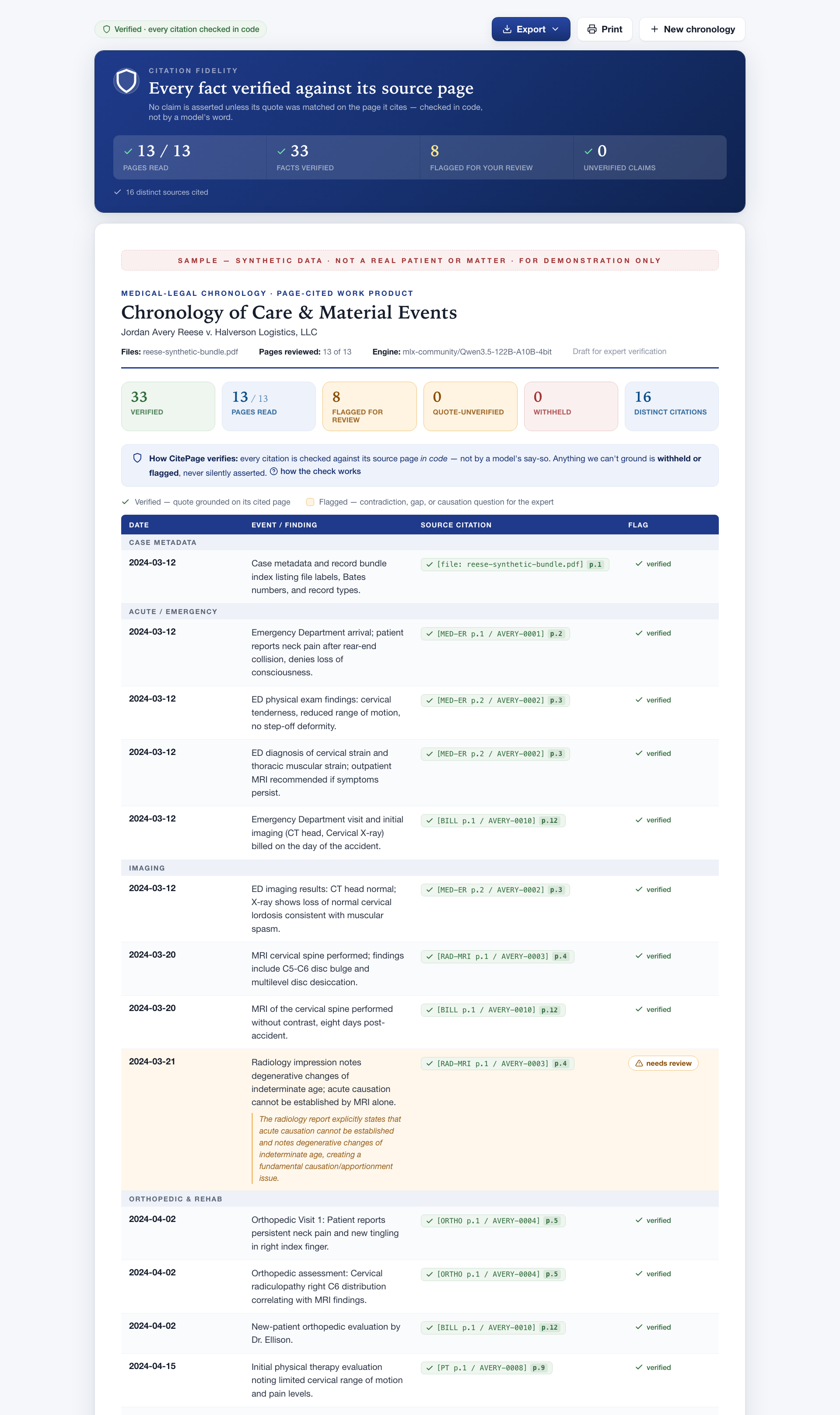
Below is an excerpt of the CitePage work product, built from a fully synthetic case. Routine entries are cited and clean; conflicts, causation questions, and gaps are flagged for your judgment — never guessed at.

app.citepage.com · Reese v. Halverson Logistics — finished chronology
CitePage results screen showing a page-cited medical record chronology for Reese v. Halverson Logistics: a navy citation-fidelity banner reading every fact verified against its source page — 13 of 13 pages read, 33 facts verified, 8 flagged, 0 unverified — above a chronology table where each event carries a green verified source-page citation, with a radiology causation question flagged for expert review.
Sample — synthetic data An actual CitePage run on a fully synthetic case bundle — no real patient or matter. Every citation shown was verified in code against its source page; the model and page counts are the engine's own.

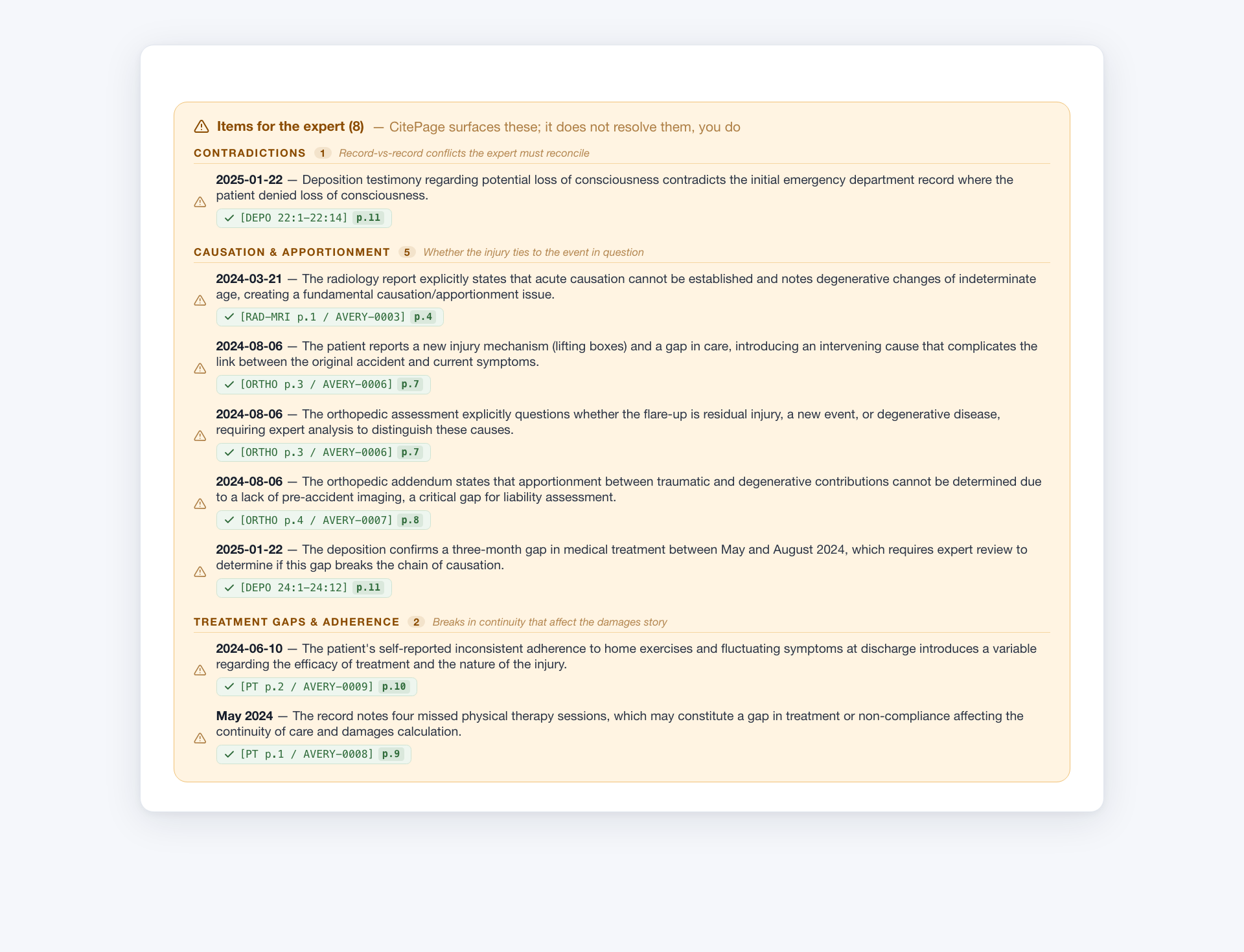
It doesn't just cite — it surfaces the hard calls and hands them to you, grouped and sourced.

Items for the expert — contradictions, causation & treatment gaps
CitePage Items for the expert panel: eight flagged items grouped into Contradictions, Causation and apportionment, and Treatment gaps and adherence — each with a plain-language reason and a verified source-page citation — that CitePage surfaces for the expert to resolve rather than answering itself.

Screenshots are an actual CitePage result on the synthetic sample, abbreviated for length. Your free chronology covers the full bundle, with a source citation on every line.

How CitePage is different

A page reference is a link. A verified citation is proof.

Plenty of tools now turn records into a chronology with page references, and you can paste a bundle into a general AI chatbot. The honest difference isn't that CitePage cites pages — it's what happens after the citation. Most tools link to a page and leave the checking to you. CitePage was built to verify, account for, and defend every line.

Citation fidelity, verified in code.

Every asserted fact is programmatically checked against the page it cites — not just hyperlinked for you to verify by hand. A wrong or unsupported citation is caught and flagged, not left for you to find on cross-examination.

Coverage accounting — no silent omission.

CitePage reports exactly what it read: "1,000 of 1,000 pages reviewed; these 3 were illegible." Pages it couldn't read are surfaced, not skipped quietly — so a dropped fact can't ambush you later.

The whole expert loop, not just the chronology.

Chronology plus an auto-maintained FRCP 26(a)(2)(B) testimony list, a Daubert-ready CV, billing & retainer tracking, and a discovery-ready audit log. Chronology-only tools stop at the timeline; your practice doesn't.

You are the author — by design.

CitePage organizes facts and your analysis; it never writes a conclusion. Every AI step is logged and exportable, so your methodology is disclosable, not a liability. (Aligned with the direction of proposed FRE 707.)

Generic AI chronology tools & pasting into a chatbot

  • Page references you click and check yourself
  • No account of pages it couldn't read
  • Stops at the chronology
  • No disclosable audit trail of the AI's work
  • Privacy varies; a public chatbot may train on what you paste

CitePage

  • Every citation verified against its page, in code
  • Coverage report — illegible pages surfaced, never dropped
  • Full expert loop: Rule 26 list, Daubert CV, billing, conflicts
  • One-click, discovery-ready audit log
  • Private, tenant-isolated, never used to train any AI

An honest framing of approaches, not a knock on any one tool — several are very good at the chronology itself. This is simply where CitePage is built to go further: it treats the citation as something to prove and account for, then carries the rest of your practice.

Compliance is the feature

Discovery-ready, not discovery-exposed.

The expert who pastes records into a public chatbot has a problem: when opposing counsel demands their AI prompts, they can't produce an organized record — and may have waived privilege over privileged material. CitePage gives you the same AI leverage with none of that exposure.

This isn't hypothetical. In CLF v. Shell (D. Conn., May 18, 2026), a court ordered an expert to produce her generative-AI prompts as discoverable methodology under FRCP 26; a vague "notes/communications" objection failed. With CitePage, every AI-assisted action — prompt, source, output, your edits — is captured in an exportable audit trail. If you're asked in discovery, you hand over a clean, organized record instead of scrambling. That doesn't weaken your methodology defense; it strengthens it.

You author the opinion.

CitePage organizes facts and your own analysis. It never writes your conclusions. You sign every word. (Aligned with the direction of proposed FRE 707 and the UK's Waksman AI guidance.)

Auto-maintained Rule 26 package.

One click exports your FRCP 26(a)(2)(B) 4-year prior-testimony list and Daubert-ready CV — kept current across engagements, not rebuilt from scratch each time.

Private by architecture.

Your records are isolated to your own tenant and never train any AI model. (Full promise below.)

Honest note: proposed FRE 707 (projected default effective date Dec 1, 2027) and the UK's proposed PD35 §3.3 AI-declaration are where the rules are heading — not yet binding law. We build for that direction so you're ahead of it, and we won't tell you it's a mandate when it isn't.

Simple, honest pricing

Pay per case, or go unlimited. One saved case pays for a year.

Three hours saved on record review, at $400/hr, is $1,200 — more than a full year of CitePage. Your first chronology is free, no card — or judge the quality on the synthetic sample above without signing up at all. Choose a plan only after you've seen it on your own case.

Per case

Pay only when you have a bundle to chronologize.

$79 per chronology
No subscription · no commitment
  • One full page-cited chronology per case
  • A source citation on every line
  • ⚠ conflict, causation & gap flags
  • Export to clean PDF / DOCX
  • Exportable audit trail for discovery
  • Private, no-train, tenant-isolated
Start with one free case →
First chronology is free. No card required.
Founding member · most popular
Monthly — unlimited

For experts carrying a steady caseload.

$99 /mo $149/mo list
Founding rate locked while you stay subscribed · cancel anytime
  • Unlimited page-cited chronologies
  • Auto FRCP 26(a)(2)(B) testimony list + Daubert CV pack
  • Expert rate-card invoicing & retainer tracking
  • Full exportable audit trail
  • Private, no-train, tenant-isolated
  • Priority turnaround on large bundles
Try your next case free →
First chronology is free. No card required to start.
Founding-member offer — first 10 experts. Lock the $99/mo founding rate for as long as you stay subscribed; we never raise it on you. The first chronology is free on either plan, precisely so you can judge the quality before you ever pay. Month-to-month, cancel anytime.

Our data-handling promise

Privacy here isn't a setting; it's the architecture.

Your case records never train anyone's AI. CitePage is built for privileged material: your documents and work are encrypted in transit and at rest, isolated to your own tenant, and never used to train or fine-tune any AI model or shared with other customers. We don't sell or repurpose your data, we keep an exportable audit trail of every AI-assisted action for your disclosure and discovery needs, and you control retention — including permanent deletion on request. Privacy here isn't a setting; it's the architecture, so your clients' confidences and your privilege stay yours.

A note from the founder

We're early — and honest about it.

C

CitePage is new, and I'd rather earn your trust than oversell. We're onboarding our first ten founding experts by doing the work alongside them — which is exactly why your first chronology is free: so you can judge citation fidelity on your own case before you ever pay.

The engine is built and stress-tested for citation accuracy — every asserted fact checked against its source page, every page accounted for — before we ever asked anyone to trust it with a case. If it isn't accurate enough to put your name on, you owe us nothing — and I want to hear why, because that's how the product gets better. The promise is narrow and we keep it: CitePage organizes the facts; you author every opinion.

— The CitePage founder · hello@citepage.com

Try it free

Try it on your next case — free.

Upload one consented case bundle. Get a page-cited chronology back, with a source citation on every line. Keep it whether or not you ever subscribe.

Questions, answered straight

Frequently asked questions

How accurate is it? Can I trust the citations?
Citation fidelity is our first design principle. Every fact links to its exact source page, so you verify in seconds rather than re-reading the bundle. Anything ambiguous or internally inconsistent gets a "needs expert review" flag instead of a confident guess. You check and sign before anything carries your name — CitePage is a force multiplier on your review, never a replacement for it.
How is CitePage different from other AI chronology tools — or pasting records into a chatbot?
Plenty of tools now produce a chronology with page references, and a general chatbot can too. The difference is what happens after the citation. Most tools hyperlink to a page and leave the checking to you; CitePage verifies each fact against its cited source page in code and reports exactly which pages it read — flagging any it couldn't — so facts aren't silently dropped. It also handles the rest of your practice the chronology-only tools don't: an auto-maintained FRCP 26(a)(2)(B) testimony list, a Daubert-ready CV, billing, and a discovery-ready audit log. And it never writes your opinion — you remain the sole author.
Will using AI expose me to a Daubert challenge?
Used the wrong way, ad-hoc AI can. CitePage is built the opposite way: it never writes your opinion, and every step is logged and exportable. If your methodology is questioned, you produce a clean audit record — which supports a Daubert defense rather than undermining it. Pasting privileged records into a public chatbot is the real exposure; this is the defensible alternative.
Is my data private? Do you train on my records?
No. Your records never train anyone's AI, they're encrypted in transit and at rest, isolated to your own tenant, and you control retention including permanent deletion. See our full data-handling promise above — privacy here is the architecture, not a checkbox.
I already use ChatGPT for this. Why switch?
Two reasons. First, output: CitePage returns a structured, page-cited, court-formatted chronology — not a chat transcript you have to reformat. Second, and bigger: a public chatbot keeps no disclosable audit trail and may compromise privilege. When opposing counsel asks for your AI methodology (as a court already ordered in CLF v. Shell, 2026), CitePage exports a clean record. ChatGPT can't.
Per case or monthly — which should I pick?
If you handle the occasional engagement, $79 per chronology means you only pay when you have a bundle to process — no subscription. If you carry a steady caseload, the $99/mo unlimited plan is far cheaper per case and adds the auto-maintained Rule 26 package and invoicing. Either way your first chronology is free, so you can decide after you've seen the quality. You can switch or cancel anytime.
Can I cancel anytime?
Yes. The monthly plan is month-to-month with no contract — cancel anytime. Founding members keep the $99/mo rate for as long as they stay subscribed. The per-case option has nothing to cancel; you simply pay when you run a case.
Do I have to upload real, privileged records to try it?
Only with your explicit consent, on a case you choose, under the data-handling promise above. If you'd rather, you can start with the sample chronology built from a synthetic case bundle (no real records) so you can judge the quality first. While we're early, we ask you not to upload records until you're comfortable with how they're handled.
How long until I get my chronology back?
Most chronologies come back the same day. Large bundles — thousands of pages — are typically ready within 24 hours, and you're notified the moment it's done. You're never left guessing about coverage: the work product reports exactly which pages were read and flags any it couldn't, so nothing is silently dropped.
What counts as one case?
One case is one matter — the bundle counsel sent you for a single engagement, however many PDFs and pages it contains. We don't meter by the page, so a 200-page bundle and a 2,000-page bundle are both one case. On the unlimited monthly plan it's moot; chronologies aren't capped. (More in our pricing.)
Is CitePage only for medical experts?
CitePage is tuned today for medical-record-heavy engagements — IME/QME, personal injury, and medical-malpractice work, where the bundle is largest and the chronology is the spine of the report. The same workflow fits any expert who has to chronologize a document bundle and stand behind it under cross-examination; medical records are simply where we started.